
Workstation & Desk Cleaning Melbourne — Sanitisation
Professional workstation and desk cleaning for Melbourne offices — daily sanitisation of high-touch surfaces using TGA-listed disinfectant at the correct dwell time, weekly full workstation wipe-down of all desk and chair surfaces, and hot desk sanitisation between different users in flexible seating and co-working environments. All products and equipment supplied.

The Most-Touched Surfaces in Your Office — Daily Sanitisation
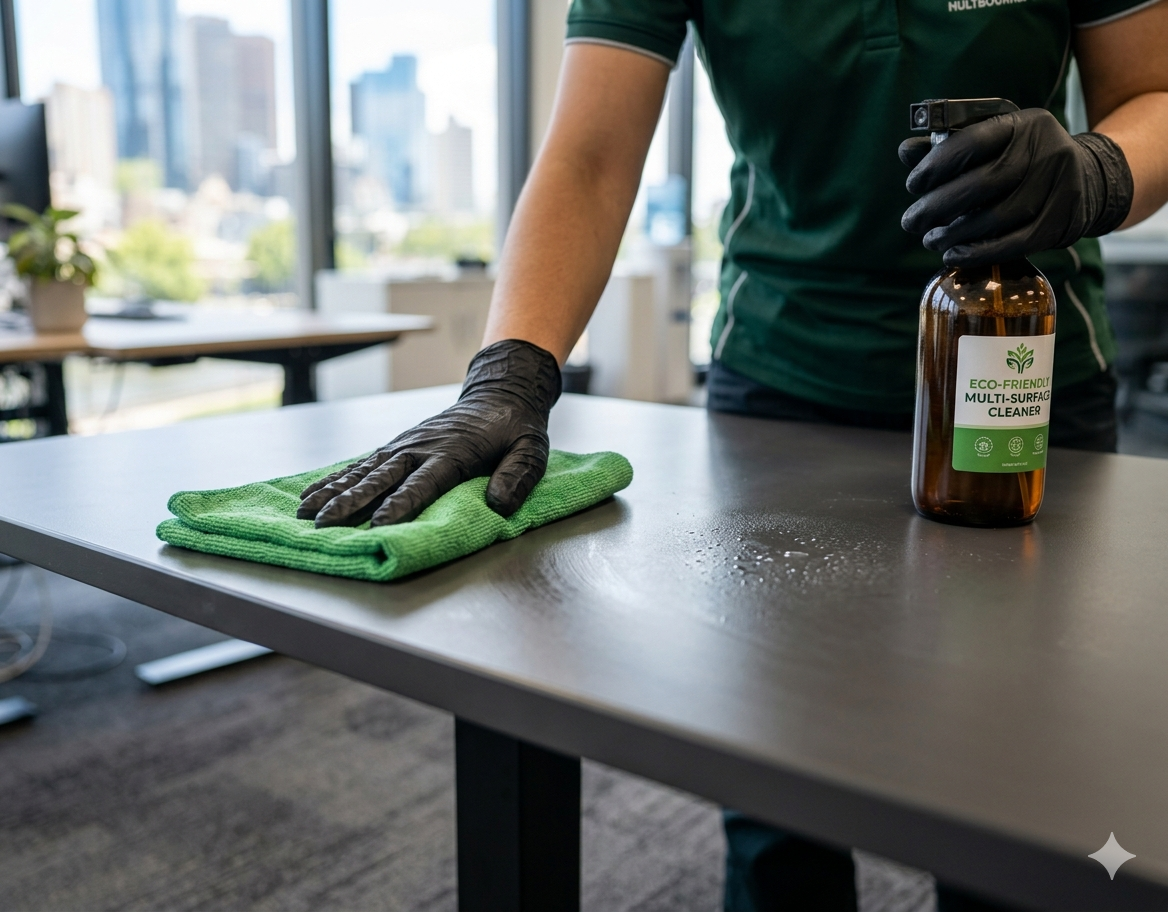
Workstation and desk cleaning involves two frequency tiers: daily sanitisation of high-touch surfaces — keyboard area, mouse mat, telephone handset, and the main desk zone — using TGA-listed disinfectant at the correct concentration and dwell time; and weekly full workstation cleaning covering all desk surfaces, monitor bezels, chair seat and armrests, desk drawer fronts, cable management tray, and any pedestal or under-desk storage. Hot desk sanitisation between different users is a third tier for flexible seating environments.
Daily & Weekly Workstation Cleaning — What Each Tier Covers
Workstation cleaning uses two complementary tiers — daily sanitisation of the surfaces touched most frequently, and weekly full cleaning of all workstation surfaces including those that accumulate dust and debris rather than hand-contact contamination. Both tiers are performed as part of the standard Golden Star workstation cleaning program at no additional charge.
The Highest-Contact Surfaces at Every Workstation
Not all surfaces at a workstation require the same sanitisation frequency. The surfaces below are the highest-contact points — touched repeatedly throughout the working day by every person who uses the workstation. These are the surfaces that require daily disinfection using a TGA-listed product at the correct dwell time, not merely a cosmetic wipe that moves contamination rather than reducing it.
The correct technique for each surface matters. Keyboards are wiped with a lightly dampened cloth — not sprayed directly with liquid disinfectant, which can penetrate between keys and damage electronics. Screens are cleaned with dry or very lightly dampened microfibre only — standard cleaning cloths scratch display coatings. The dwell time for the disinfectant on each surface must be observed before wiping — product sprayed and immediately wiped does not achieve the pathogen reduction the TGA listing requires.
Keyboard & Keyboard Area
The keyboard surface and the desk area immediately around it — where hands rest during typing — is the highest-contact surface at any workstation. Wipe with a lightly dampened microfibre cloth loaded with TGA-listed disinfectant. Do not spray directly onto the keyboard. The area between keys accumulates debris that compressed air can dislodge before wiping.
Daily sanitiseMouse & Mouse Mat
The mouse and mouse mat — or the direct desk area where the mouse is used — sustain continuous palm and finger contact throughout the working day. The mouse top, sides, scroll wheel area, and the mat surface all require daily disinfection. Mouse mats with a fabric surface accumulate skin cell debris and require periodic replacement or washing in addition to daily disinfection of the surface.
Daily sanitiseTelephone Handset & Keypad
The telephone handset — particularly the earpiece and mouthpiece — is in close contact with the face and is one of the highest contamination-risk surfaces at any desk. Daily disinfection of the earpiece, mouthpiece, keypad, and cradle area is standard. In hot desk environments, telephone sanitisation between users is as important as keyboard and desk surface sanitisation.
Daily sanitiseChair Armrests
Chair armrests are a frequently overlooked high-contact surface — rested on continuously during the working day and rarely included in daily desk cleaning routines. In hot desk environments, armrests require between-user sanitisation alongside the desk surface. In fixed-desk environments, weekly sanitisation as part of the full workstation clean is the minimum appropriate frequency.
Daily (hot desk) · weekly (fixed)Monitor Bezel & Controls
The monitor bezel — the frame surrounding the screen — and any physical controls on the monitor are frequently touched when adjusting the display or positioning the screen. The screen surface itself is cleaned with dry or very lightly dampened microfibre only — standard cleaning products can damage anti-glare coatings. The bezel and stand are cleaned with regular disinfectant on weekly full cleans.
Weekly clean · microfibre for screenMain Desk Surface — Work Zone
The desk surface in the immediate work zone — the area where documents are placed, hands rest outside the keyboard, and objects are set down and picked up throughout the day — requires daily sanitisation with TGA-listed disinfectant. The broader desk surface beyond the immediate work zone is cleaned weekly as part of the full workstation wipe.
Daily (work zone) · weekly (full surface)Hot Desk Cleaning — Between-User Sanitisation in Flexible Offices
Hot desking and flexible seating arrangements are increasingly standard across Melbourne offices — particularly in professional services, technology, and financial services sectors where staff are frequently mobile or split time between office and remote work. In these environments, the same desk surface is used by multiple different people across a single day or across successive days without a fixed assignment.
The hygiene standard required for a hot desk environment is different from a fixed-desk environment. In a fixed desk, the primary hygiene concern is individual accumulation — the same person's contact contamination building up over time. In a hot desk, the primary concern is cross-user contamination — one person's contact contamination transferred to the next user through shared surfaces. This requires TGA-listed disinfectant applied at the correct dwell time between users, not merely a cosmetic wipe that moves surface contamination rather than reducing it.
Members of co-working spaces and employees in activity-based workplaces have an expectation that the desk they sit at has been sanitised from the previous user — not just visually cleaned. Golden Star's hot desk sanitisation protocol addresses this expectation with a consistent, documented approach that is the same for every desk on every visit, regardless of whether the desk appears visually clean or not.
Workstation & Desk Cleaning — Questions Answered
Common questions from Melbourne office managers about professional workstation cleaning — frequency, hot desk sanitisation, keyboard cleaning techniques, and what's included. Call 0484 042 336 for same-day quotes.
Get a Quote for Workstation Cleaning in Melbourne
Tell us your office address, number of workstations or desks, and whether you have a hot desk or flexible seating environment — we provide a tailored daily and weekly workstation cleaning quote within 2 business hours. TGA-listed disinfectants, correct dwell time applied, all products supplied. No lock-in contracts.