Low-tox, low-waste, stated honestly
Green and Safe Office Cleaning
Eco-friendly office cleaning in Melbourne, described honestly: low-fragrance, low-tox products for everyday cleaning, microfibre and concentrates that cut water and plastic, and disinfectant used only where it is actually needed. Every product comes with a safety data sheet. This page is part of how Golden Star works.
Our approach
- Mildest product that works
- Fragrance-free on request
- Refills, not new bottles
- Safety sheet for everything
- Low-tox firstDetergent before disinfectant
- Less waterMicrofibre flat mops
- Less plasticConcentrates and refills
- SDS on siteFor every product
Green cleaning, honestly
What does green office cleaning really mean?
Green office cleaning means using the gentlest product that does the job, cutting water, plastic and chemical use, and keeping staff away from fumes and heavy fragrance. It does not mean every product is chemical-free or certified, and it never means skipping disinfection where hygiene needs it.
Choices we make every visit
- Neutral detergent for most surfaces, not disinfectant everywhere
- Microfibre that lifts dirt with far less product
- Concentrates mixed on site, so fewer bottles are made and thrown out
- Low or no fragrance, so nobody gets a headache
- Right product for each surface, so nothing is scrubbed twice
Claims we will not make
- That any product is chemical-free, because water is a chemical too
- That every item we use carries an eco certification
- That disinfectant can be replaced by vinegar in a bathroom
- That green products clean worse, when used properly they do not
- That a leaf on a label proves anything on its own
Green claims attract a lot of marketing. The ACCC's guidance on environmental claims tells businesses to back up what they say and avoid vague labels, and we hold ourselves to the same test. If we cannot explain why a method is better, we do not call it green.
Bathrooms, kitchens and clinical areas still need disinfection at the right points, and using a weak product there to look eco-friendly would put staff at risk. So the rule is simple: clean everything with the mildest effective product, and disinfect only the touch points and surfaces where germs spread.
Products we use
Which cleaning products are safe for offices?
The safest cleaning products for offices are neutral detergents, water-based glass cleaners and microfibre, used for almost everything, with stronger products saved for specific jobs. The table shows each type of product we use, where it goes and how gentle it is. Our written product list names each brand for your records.
| Product type | Where we use it | How gentle | Why |
|---|---|---|---|
| Neutral detergent | Desks, floors, most surfaces | Mildest | Lifts everyday dirt without residue or fumes |
| Water-based glass cleaner | Glass, mirrors, screens edges | Mild | Streak-free with very little product |
| Food-safe sanitiser | Kitchen benches and tables | Moderate | Safe on food-contact surfaces after cleaning |
| Bathroom cleaner | Basins, tiles, fittings | Moderate | Removes soap scum and scale |
| TGA-listed disinfectant | Toilets, touch points, clinical areas | Stronger | Only where germs spread, used as labelled |
| Specialist spotters | Individual carpet and upholstery stains | Stronger | A few drops on one mark, never floor-wide |
Every product in the table comes with a safety data sheet, kept in a folder in your office and listed in a register we give you, which is what WorkSafe Victoria asks of employers for hazardous substances. If someone on your team has asthma, allergies or chemical sensitivities, tell us and we switch to fragrance-free versions and adjust where stronger products are used.
People often ask about vinegar and bicarb soda. They have their place at home, but not on office surfaces: vinegar etches natural stone benchtops and can dull some coatings, it is not a registered disinfectant, and a kitchen that smells of it is not what most offices want. Commercial neutral detergents do the same everyday job more gently, and we save the stronger products for the handful of places that need them.
Less waste
How do you reduce water, plastic and waste?
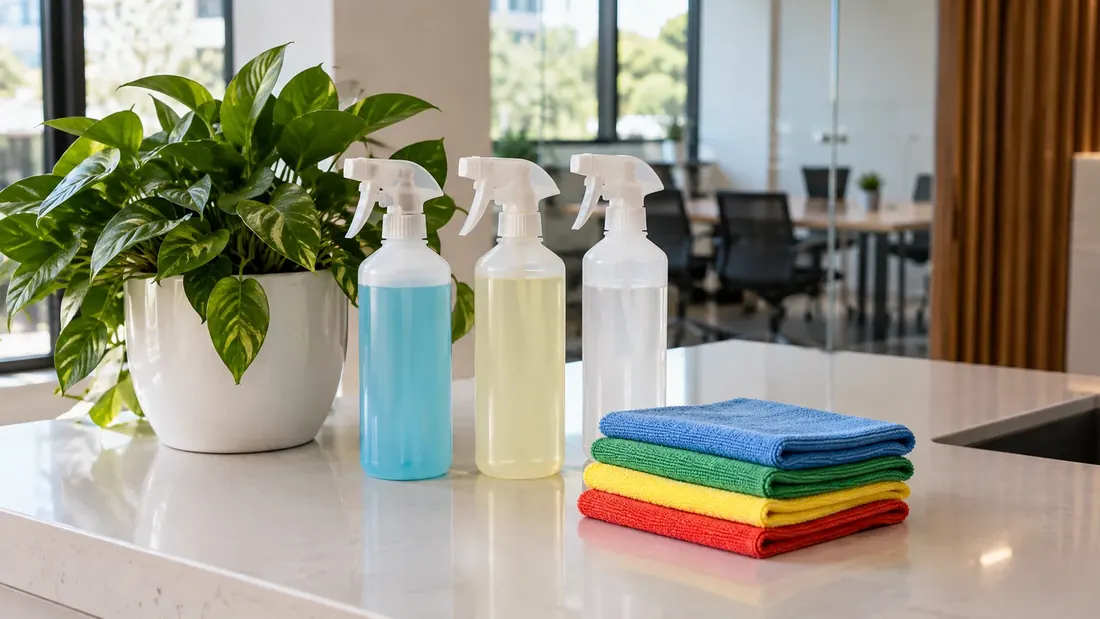
We reduce waste mostly through method rather than product labels: microfibre instead of paper towel, flat mops instead of buckets of water, concentrates decanted into reusable bottles, and recycling kept separate all the way to the building's bins. Each of these is visible on a normal visit.
Cloths and mop heads are washed and reused hundreds of times instead of throwing away paper and sponges.
A pre-dampened flat mop uses a small fraction of the water a string mop and bucket need, and floors dry faster.
Products are diluted on site into labelled reusable bottles, so far fewer plastic containers are made and discarded.
Paper, co-mingled recycling, soft plastics where your building accepts them, and food waste go to the right bins.
Small habits add up over a year. Switching off lights and monitors left on, reporting a dripping tap the same night, and closing blinds on hot afternoons all cut an office's energy and water use, and they cost nothing. Our crews do them on every visit because they are part of looking after a building, not because they make a good headline.
How we choose products for a new site
- Start with neutral detergent for every surface it can handle
- List the few places that genuinely need disinfectant
- Check surface makers' advice for stone, timber and coatings
- Ask about staff sensitivities and any site product rules
The result is a short product list rather than a long one. Most offices need four or five products in total, and the fewer we bring, the fewer safety sheets you hold and the less there is to go wrong. Storage matters too: products are kept in a labelled, closed cleaner's cupboard or taken away after each visit, never left open under a kitchen sink where staff might mistake one bottle for another.
Staff wellbeing
Why does product choice matter to the people in the office?
Product choice matters because office air is shared and often recirculated. Strong fragrances, aerosol sprays and heavy disinfectant used across every desk can linger into the morning, and some staff notice them far more than others. Milder products used with microfibre leave surfaces clean without leaving a smell behind.
People with asthma, hay fever, migraines or chemical sensitivities are often the first to feel an over-scented office, and they are rarely the ones who choose the cleaning products. We avoid aerosols, use trigger sprays onto cloths rather than into the air, and choose unscented versions wherever an equivalent exists.
A clean office should smell of nothing much at all. If staff comment on a cleaning smell when they arrive, tell us: it usually means a product is being overused or is the wrong one for that surface, and it is an easy thing to change.
- No aerosols on regular visits
- Spray onto the cloth, not the air
- Unscented where possible
- Windows or ventilation on during use
Quote
Can I ask for greener cleaning in my quote?
Yes. Tell us what matters to your office, whether that is fragrance-free products, fewer disinfectants, or products carrying a particular eco-label, and we build the scope and product list around it. Green choices rarely change the price, and we tell you in writing if one does.
- Tell us your priorities. Sensitivities, certifications or sustainability targets.
- Review the product list. Each product, where it is used and its safety sheet.
- Start cleaning. With the same products on every visit, recorded in the scope.
Questions
What do sustainability teams ask?
Questions that come up whenever green cleaning is part of the brief, whether it comes from a sustainability team, a building rating or simply staff who care about it.